Most roof leak repairs in the Seattle area land in one of two ranges. Isolated repairs typically cost $300 to $1,500. Larger or structural repairs, where water has damaged the decking or the fix covers a wider section of roof, typically cost $1,500 to $3,500. Where your repair falls depends mainly on four things: how easy the roof is to get onto, how steep it is, what it is made of, and how far the water has traveled before anyone stopped it.
The only way to turn those ranges into a real number is to find the leak’s source and see the roof in person. Our roof leak repair service starts with a free inspection from the attic and the roof, and you get a written quote before any work begins. The rest of this article explains what goes into that quote, so you can read one with confidence.
The Two Ranges Most Leak Repairs Fall Into
Roofers do not price leaks by the size of the stain. They price the work it takes to close the opening and repair whatever the water has damaged. That work tends to sort into two broad groups.
Isolated Repairs: $300 to $1,500
An isolated repair fixes one failed part on a roof that is otherwise in good shape. The water has not had time to do much beyond the underlayment, and the crew can close the leak without opening a large area. Typical examples include a cracked rubber collar on a pipe boot, a nail that has backed out and lifted a shingle, a short run of flashing that has pulled loose along a wall, or a handful of shingles that have lifted or cracked.
Most leak calls start here. The earlier a leak is caught, the more likely it is to stay in this range.
Larger or Structural Repairs: $1,500 to $3,500
A repair moves into the higher range when the job gets bigger in area or goes deeper into the roof. That usually means the water has reached the decking and some of it has to be cut out and replaced, the repair covers a longer stretch of roof, or there is more than one entry point to close. In each case the crew is rebuilding several layers of the roof rather than swapping out one part.
What Drives the Quote
Within those ranges, a handful of factors do most of the work, and the last one matters most.
Access
Before anyone can fix a leak, the crew has to get onto the roof safely and get materials up there. A single-story house with a clear driveway and open ground around it is quick to set up on. A three-story house on a hillside lot, a roof above a glass sunroom, or a home with dense landscaping along every wall takes longer to access and protect, and that time is part of the price.
Pitch
Steep roofs are slower and more demanding to work on. Once a roof gets steep enough, the crew needs fall protection, roof jacks and planks to stand on, and every movement takes more care. The same repair on a low-pitch rambler and a steep two-story roof can take noticeably different amounts of time, even when the parts are identical.
Material
Composition shingles are the most common roofing material around Seattle and the simplest to repair. Other materials each bring their own requirements. Metal roofs need matching panels, trim and fasteners. Tile has to be lifted carefully so the surrounding tiles are not broken. Cedar shake and flat roof membranes such as TPO, PVC and modified bitumen each have their own repair methods and parts. None of these makes a repair unreasonable, but the material affects both the time and the parts a repair needs.
The Condition of the Roof Around the Leak
The age and condition of the surrounding roof shape the repair as well. Newer shingles bend and lift cleanly, so the crew can work under them and lay them back down. Older, brittle shingles crack when they are lifted, which means more of them have to be replaced to make the repair watertight. The same goes for flashing: a sound piece can often be resealed, while a rusted or bent one has to come out.
How Far the Water Has Traveled
This is the factor you have the most control over. A leak caught while the water is still at the underlayment is a small job. Once the water has soaked into the decking for a season, the crew has to remove shingles over a wider area, cut out the softened wood, install new sheathing and rebuild everything above it. That is the single biggest difference between a repair at the low end of the ranges and one at the high end.
It is also why waiting rarely saves money. We explain how that progression plays out, stage by stage, in what a roof leak actually costs if you wait.
Why the Source Matters More Than the Stain
Most people judge a leak by what they can see: a stain on the ceiling, a drip into a bucket. The roofer is pricing something else entirely, the point where water gets into the roof. The two are often not in the same place.
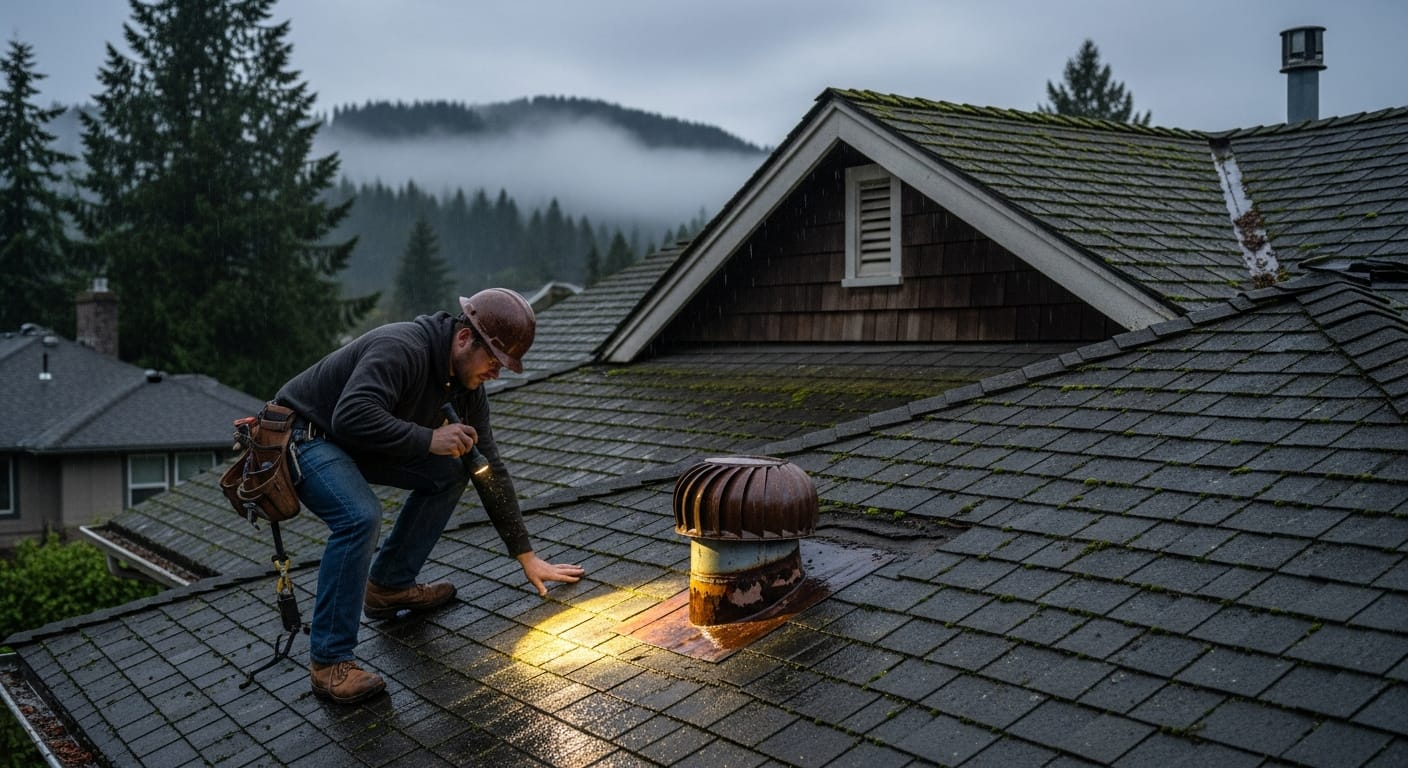
Water that slips under a shingle or behind flashing can run along the decking or down a rafter before it finally drips. That means the stain in your hallway may come from a pipe boot several feet away, or from flashing on the far side of a chimney. A repair that patches the shingles directly above the stain can look fine and still leave the real opening untouched.
Tracing the source is part of the job, and it is part of what you are paying for. A proper inspection looks at the attic for the water trail and at the roof for the failed part. When the source is still not obvious, a controlled water test, wetting one section of roof at a time while someone watches from inside, settles it. The result is a repair aimed at the right spot, which is the only kind worth paying for.
What a Written Estimate Should Show
Whoever you hire, the estimate you sign should answer the questions that matter before any work starts. A good one covers:
- The source of the leak. Not just “fix leak over hallway,” but what failed and where, ideally with photos.
- The scope of work. What will be removed, what will be replaced and how large an area is involved.
- Materials. What will be installed, and how it will be matched to the roof you already have.
- Hidden damage. How any additional damaged decking found once the roof is opened will be handled and priced, so there are no surprises halfway through.
- The price. A fixed number for the defined scope, with line items rather than a single lump sum.
- Timing. When the work can be scheduled and how long it should take.
- Warranty. The workmanship warranty on the repair and any manufacturer warranty on the materials.
Every K Single Corp estimate is free, written and itemized, so you can see what you are paying for and compare it fairly.
Questions to Ask Before You Approve a Repair
A few questions help you tell a solid quote from a weak one:
- Where exactly is the water getting in? You should get a clear answer, and ideally a photo.
- What happens if the decking is worse than expected? Ask how that would be handled before it comes up.
- Will the repair match my roof? Shingle colors get discontinued, and new shingles can look brighter until they weather.
- Is the rest of the roof in good enough shape for a repair to last? An honest roofer will tell you if you are spending money on a roof near the end of its life.
- Who does the work? Make sure the contractor is licensed and insured in Washington, and that their own crew or a crew they supervise is doing the repair.
What Happens at a Leak Inspection
Because the price depends on the source, the inspection is where the quote really comes from. Ours follows the same order every time.
We start inside, at the stain, and note where it sits relative to chimneys, skylights, vents and walls. Then we go into the attic and look at the underside of the roof deck, following any water trail, dark staining or damp insulation uphill toward where it began. From there we go up on the roof and check every likely entry point in that area: flashing, pipe boots, valleys, fasteners and the shingles themselves.
If the source is clear, we photograph it. If it is not, we run a water test on the suspect sections. Either way, you end up with the source identified, photos of what we found and a written quote that matches the actual problem.
Why the Cheapest Quote Is Not Always the Cheapest Repair
When you compare quotes for a leak, the lowest number can be tempting. It is worth asking what that number actually buys.
A common low-cost fix is a bead of roofing sealant over the spot where water seems to be getting in. Sealant can hold for a while, but it dries, shrinks and cracks in the sun and the cold, and it does nothing about a pipe boot that has split or flashing that was never lapped correctly. When the sealant fails, the leak comes back, often after it has spent another wet season soaking the decking.
A proper repair replaces the part that failed and restores the layers around it the way they were meant to be installed. It can cost more on the day, but it is usually the last time you pay for that leak. Two cheap visits and a round of interior repairs almost always cost more than one repair done right.
What Usually Is Not in a Leak Repair Price
A roof leak repair quote covers the roof. Depending on how long the leak ran, you may also have work to do inside the house once the roof is sealed.
Stained or sagging drywall, wet insulation and damaged paint are usually handled separately, after the roof is closed and the area has had time to dry. Ask your roofer whether the quote includes any of that work, or whether you should plan for it on its own. Knowing up front keeps the budget honest and avoids the unpleasant surprise of a finished roof and a ruined ceiling.
When a Repair Stops Making Sense
Repair is the right call on most roofs with a leak. It stops making sense when leaks keep showing up in different places, when the shingles are brittle or bare of granules across the whole roof, or when decking is soft in several areas. At that point you are paying repeatedly for a roof that is wearing out everywhere at once.
If you are weighing that decision, our roofing cost calculator gives you a replacement price range for your home in a couple of minutes. It is a useful way to compare what you are spending on repairs with what a new roof would cost, and our crew will give you an honest recommendation either way when we inspect.
Paying for a Larger Repair
Most leak repairs are small enough to pay for outright. When the water has done more damage and the repair lands in the larger range, financing is available for roof repairs as well as replacements, with monthly payments and no penalty for paying off early. It can help you fix the problem now instead of waiting and letting the leak grow.
How to Keep Your Repair at the Low End
Everything in this article points to the same advice: the cheapest leak repair is the one done early.
- Check your attic a couple of times through the wet season, looking for damp spots on the underside of the roof deck.
- Look at your ceilings, especially near chimneys, skylights and exterior walls, and do not paint over a new stain before the leak is fixed.
- Keep valleys and the uphill side of chimneys and skylights from filling up with needles and debris, which hold water against the roof.
- Call as soon as you see a sign of a leak, instead of waiting to see whether it happens again.
- Keep the photos and notes from any past repairs, so the next roofer can see what has already been fixed and where.
The Bottom Line
In the Seattle area, most roof leak repairs cost $300 to $1,500 for isolated repairs and $1,500 to $3,500 for larger or structural repairs. Access, pitch, material and, above all, how far the water has traveled decide where yours lands. A good estimate tells you exactly what failed, what will be done and what it will cost, in writing, before work starts.
To get that estimate for your roof, schedule a free inspection through our roof leak repair page or call (206) 659-4349. We will trace the leak to its source and give you a written, line-item quote.