Some minor roof repairs are safe to handle yourself, like replacing a few cracked shingles on a dry, single-story roof. However, most roof repairs should be left to a licensed professional because DIY work voids manufacturer warranties, creates safety risks, and often fails to address the underlying cause. Professional roof repairs in Seattle cost $300 to $1,500 for common issues, and that price includes the warranty protection and insurance coverage that DIY work cannot match.
This guide is intentionally honest. Some roof repairs really are safe to DIY, and we will tell you which. Most are not, and we will explain why.
Roof Repairs You CAN Safely DIY
Under specific conditions, these repairs are within reach for a careful homeowner.
Replacing 1 to 3 Visible Shingles
If wind has blown off a few shingles in a clearly visible spot on a single-story home with a low-pitch roof (4:12 or less), replacement is feasible. You’ll need:
- Matching shingles (or close enough that the difference will be invisible from the ground)
- Roofing nails
- A ladder that reaches safely to the gutter
- Non-slip shoes
- A dry day
The actual replacement involves carefully lifting the shingle above the damaged spot, removing the damaged shingle, sliding the new one into place, and nailing it appropriately. This works for simple shingle replacements but not for damage involving the underlayment or decking below.
Resealing a Cracked Pipe Boot (Maybe)
If you can clearly see a crack in the rubber gasket around a plumbing vent and you can reach it safely from a ladder, applying roofing sealant from a tube can extend the life of the boot. This is a temporary fix, typically lasting a few months to a year before the boot needs full replacement.
For most homeowners, even this is borderline. Pipe boots are often near the ridge or on steeper sections, requiring more roof access than is comfortable. If you cannot reach the boot from a stable ladder position, skip this one.
Clearing Gutters and Visible Roof Debris
Gutter cleaning is the most accessible roof-adjacent maintenance. If you have a sturdy ladder and can work safely from gutter level (without stepping onto the roof), clearing leaves, twigs, and debris is straightforward.
Same applies to visible roof debris that you can reach with a roof rake or extension tool. You can clear debris without ever stepping onto the roof itself.
Ground-Level Moss Treatment
Many moss-killing products are designed for ground or gutter-level application. The product is sprayed into a hose attachment that reaches the roof from a safe distance. Effective and safe.
Replacing a Damaged Gutter Section
Gutters and downspouts are accessible from a ladder. Replacing a bent or damaged section, re-attaching loose hangers, or sealing a leaking joint with gutter sealant are all reasonable DIY tasks.
Caulking Minor Trim Gaps
Where exterior trim meets the roofline (siding to fascia, trim joints), small gaps can be caulked from a ladder. This is general home maintenance more than roof repair.
Roof Repairs You Should NEVER DIY
These categories are universally professional work.
Flashing Repair or Replacement
Flashing is the metal that seals roof penetrations and transitions. It’s the #1 source of leaks on aging roofs. Flashing repair requires:
- Lifting and re-bedding shingles around the flashing
- Cutting and bending sheet metal correctly
- Sealing with appropriate materials (roofing cement, butyl, or membrane sealants)
- Understanding how water moves around the penetration
DIY flashing repair almost always fails. The work looks fine when finished but leaks within months. Professional flashing repair with proper warranty coverage is the only sensible approach.
Anything That Requires Accessing the Roof Deck
If the repair requires lifting shingles to expose the underlayment or decking below, you are doing roofing work, not maintenance. The complexity, materials knowledge, and proper installation techniques are beyond what most homeowners can handle.
Structural Repairs
Sagging rooflines, broken rafters, rotted decking, or any structural issue requires expertise that DIY cannot deliver. Structural mistakes can lead to roof collapse. Always professional.
Multi-Story Homes
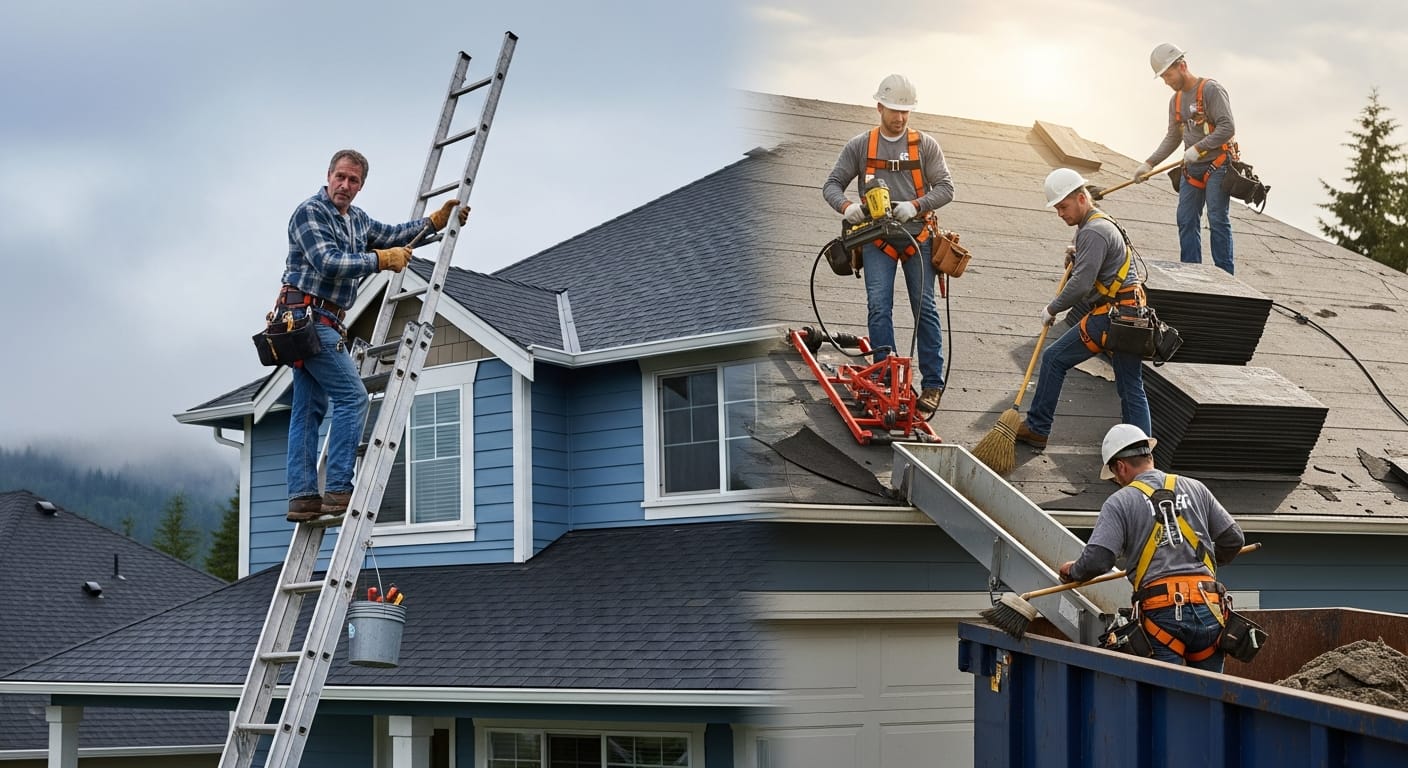
Falls from two-story homes are often fatal. The risk-reward equation completely shifts compared to single-story repairs. Professional roofers use safety harnesses, scaffolding, and have years of experience working at height. Homeowners do not. Multi-story is always professional.
Wet, Mossy, or Icy Conditions
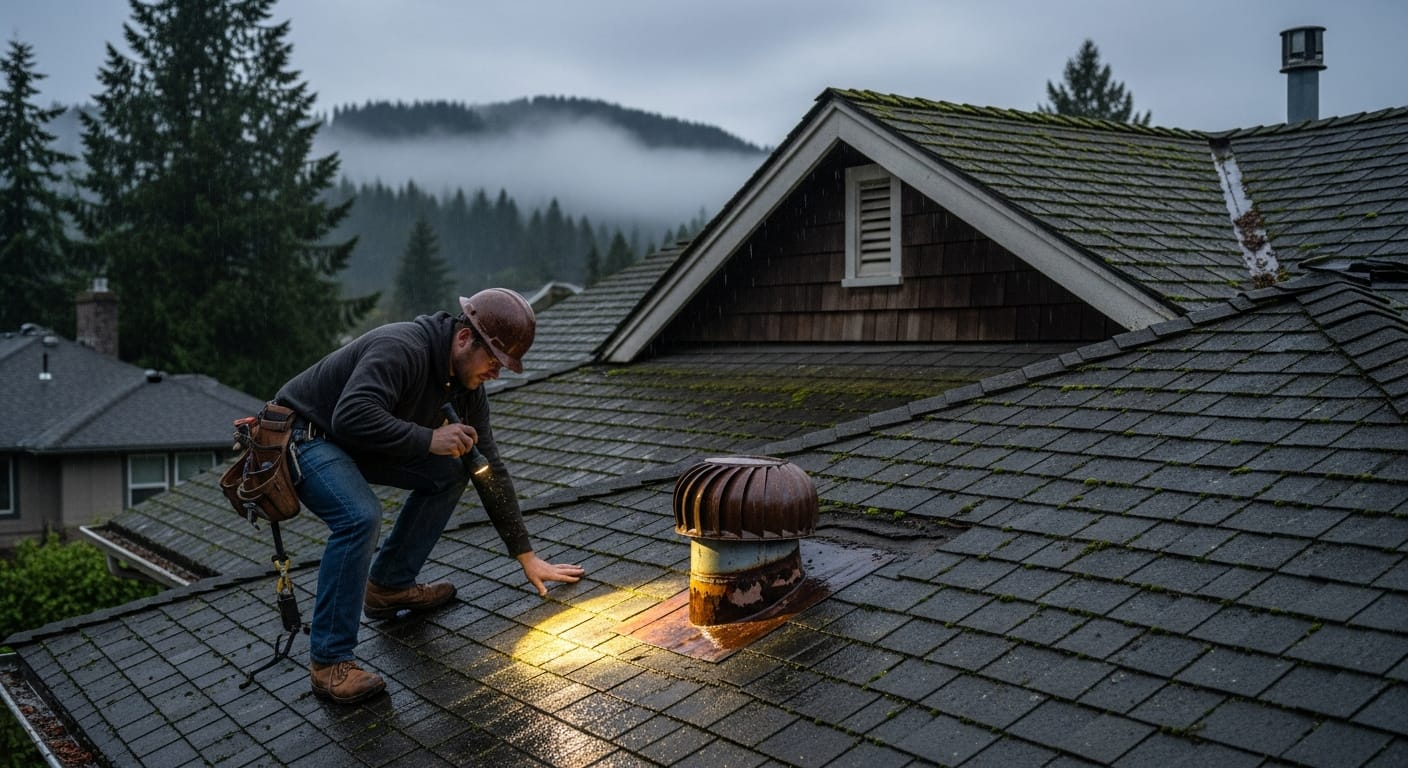
PNW-specific. Seattle roofs are wet for much of the year, and moss makes surfaces dangerously slippery. Even experienced roofers refuse to work in wet conditions for safety reasons. Homeowners definitely should not.
Flat Roof Membrane Repairs
TPO, EPDM, and modified bitumen all require specialized tools, materials, and techniques. Heat welding, seam taping, and proper membrane patching require professional equipment and training. DIY flat roof repair almost always creates more problems than it solves.
Anything Involving Electrical Penetrations or Solar Panels
Electrical conduit through the roof, solar panel roof attachments, and HVAC equipment penetrations all require specific approaches. Mixing roofing work with electrical or solar systems creates risks that homeowners cannot manage.
Active Leaks With Unknown Source
Water travels along rafters before dripping. The visible ceiling drip is rarely directly below the actual entry point on the roof. DIY repairs at the visible spot often fail because the actual source remains unaddressed. Professional leak detection identifies the true source.
The Safety Reality
Falls from roofs are not theoretical. They happen.
Falls are the leading cause of construction-related deaths. OSHA tracks this. Construction workers, who are trained and equipped for height work, die from roof falls every year in the US.
Residential roof falls send 50,000+ people to the ER annually. Most are DIYers attempting “simple” tasks like cleaning gutters, replacing shingles, or hanging holiday lights. Many cause permanent disability.
Steep roofs require harness systems. Pitches of 6:12 or higher (common in Seattle) require fall protection that most homeowners do not own. Without harnesses, even a small slip becomes an uncontrolled fall.
PNW roofs are uniquely dangerous. Seattle’s wet climate keeps roofs damp for weeks. Moss accumulation makes surfaces slippery even when they appear dry. Morning dew can persist until late morning during fall, winter, and spring.
Professional roofers train for years. Walking on roofs is a learned skill. Where to step on different materials, how to move at angles, how to work near edges. Years of experience inform decisions that homeowners simply cannot match.
The cost of a fall is far higher than the savings from DIY work. A single ER visit with no permanent injury costs more than most professional repairs. A serious injury costs vastly more. The math does not favor DIY when safety is properly weighted.
Warranty and Insurance Implications
The financial case against DIY repair is often the strongest argument.
Manufacturer Warranties
All major shingle manufacturers (GAF, CertainTeed, Owens Corning, Malarkey, IKO, Atlas) require certified contractor installation and repair to maintain warranty coverage. DIY repairs:
- Void warranty coverage on the affected area at minimum
- May void the entire roof’s warranty depending on manufacturer
- Are documented in any future warranty claim review
- Cannot be transferred to subsequent owners (warranty is tied to certified installation)
A typical 30-year shingle warranty has $5,000 to $20,000 of potential value. Voiding it to save $200 on DIY repair is poor financial logic.
Homeowners Insurance
Insurers handle DIY repairs in a few ways:
- Damage from DIY failure may not be covered. If your sealant attempt fails and water damages the interior, the claim can be denied citing self-inflicted damage.
- Pre-existing DIY may reduce coverage. Some insurers reduce coverage or increase premiums on roofs with documented DIY repair history.
- Liability shifts to you. A poorly done DIY repair that contributes to property damage shifts financial liability away from the manufacturer or installer to you personally.
Workmanship Warranties
Professional repairs include workmanship warranties. K Single Corp provides 10 years of coverage on repair work. If the repair fails within that period, we return and fix it at no cost. DIY work has no such backstop.
Future Home Sales
When you sell your home, the inspection report will likely identify DIY repair work. Buyers and inspectors view this with skepticism, and it can complicate sales, reduce price, or trigger contingencies for professional remediation.
Cost Comparison: DIY vs Professional
The honest cost comparison is more nuanced than the headline material costs.
| Repair Type | DIY Materials | DIY Time | Professional Cost |
|---|---|---|---|
| Replace 3 shingles | $30–$60 | 2–3 hours | $200–$400 |
| Replace pipe boot | $30–$50 | 2–3 hours | $250–$500 |
| Seal small visible crack | $15–$25 | 1 hour | $200–$350 |
| Repair flashing (NOT recommended DIY) | $50–$150 | 4+ hours | $400–$1,200 |
| Replace damaged gutter section | $50–$150 | 2–3 hours | $300–$600 |
| Apply moss treatment | $30–$80 | 1–2 hours | $200–$500 |
The DIY material costs look attractive. But the comparison ignores:
Time value. The hours you spend on a DIY repair have value. Professional crews complete most small repairs in 1 to 2 hours including travel and cleanup.
Failure rate. DIY repairs fail at significantly higher rates than professional work. The cost of a failed DIY repair (water damage, repeated attempts, eventual professional repair) often exceeds the cost of professional work from the start.
Warranty value. DIY voids warranty coverage worth thousands in potential future claims.
Risk-adjusted cost. Multiply potential failure cost by probability of failure. Even a 20% DIY failure rate adds significant expected cost to the comparison.
Hidden water damage. A failed DIY repair that causes interior water damage averages $2,500 to $7,500 in remediation costs.
When you do this math honestly, professional repair almost always wins for anything beyond the simplest tasks.
PNW-Specific DIY Risks
Beyond the universal warnings, Seattle adds specific factors.
Limited safe-access window. With 150+ rain days per year and humidity that keeps roofs damp, your window for safe DIY access is narrower than in drier climates. By the time conditions align with your schedule, weeks may have passed.
Moss makes everything slippery. Even when a roof looks dry, moss colonies hold moisture and create slick patches. PNW roofs covered in moss are uniquely treacherous.
Cedar shake is fragile. Cedar shake roofs are common in older Seattle neighborhoods. They are brittle, uneven, and easily damaged by foot traffic. Walking on cedar shake without specialized experience often causes more damage than the original problem.
Flat roofs collect standing water. Flat or low-slope roofs in Seattle often have ponding water during the wet season. Standing water creates slip hazards and means foot traffic damages the membrane.
Cool, wet weather extends drying times. Sealants, caulks, and adhesives that cure quickly in dry climates take much longer to set in PNW conditions. Improper application during cool, wet weather often results in failure.
If you wait for ideal conditions, you wait a long time. Many homeowners postpone DIY repair waiting for “the right day.” A professional can often schedule repair faster than the weather cooperates with DIY plans.
How to Know When to Call a Professional
The decision tree for any roof repair:
- Can you identify the source from inside the attic? If no, call a pro.
- Does the repair involve any roof penetration? If yes, call a pro.
- Is the roof more than 4:12 pitch? If yes, call a pro.
- Is the home two stories or taller? If yes, call a pro.
- Is the damage limited to a small, visible area? If no, call a pro.
- Is the roof under warranty? If yes, call a pro (DIY voids it).
- Do you own proper safety equipment (harness, roof brackets, non-slip shoes)? If no, call a pro.
- Is the roof wet, mossy, or icy? If yes, call a pro.
- Has the issue been recurring? If yes, call a pro.
If you answered “no” to all of these (single-story, low-pitch, dry, sound, simple, accessible, equipped), DIY may be appropriate. For everything else, professional repair is the right call.
Get a Professional Roof Repair Estimate
K Single Corp provides written estimates for all roof repair work across King, Snohomish, and Pierce counties. Whether you need a 5-shingle replacement or major flashing work, we provide honest assessments and warranty-backed repairs.
Schedule your free estimate or call (206) 659-4349 for same-week scheduling. Most repair work can be completed within 1 to 2 weeks of the initial estimate.
For more on related topics, see our roof repair service page, our companion guides on how to find a roof leak, emergency roof repair, and storm damage roof repair, and our broader resource on common roof problems in Seattle.