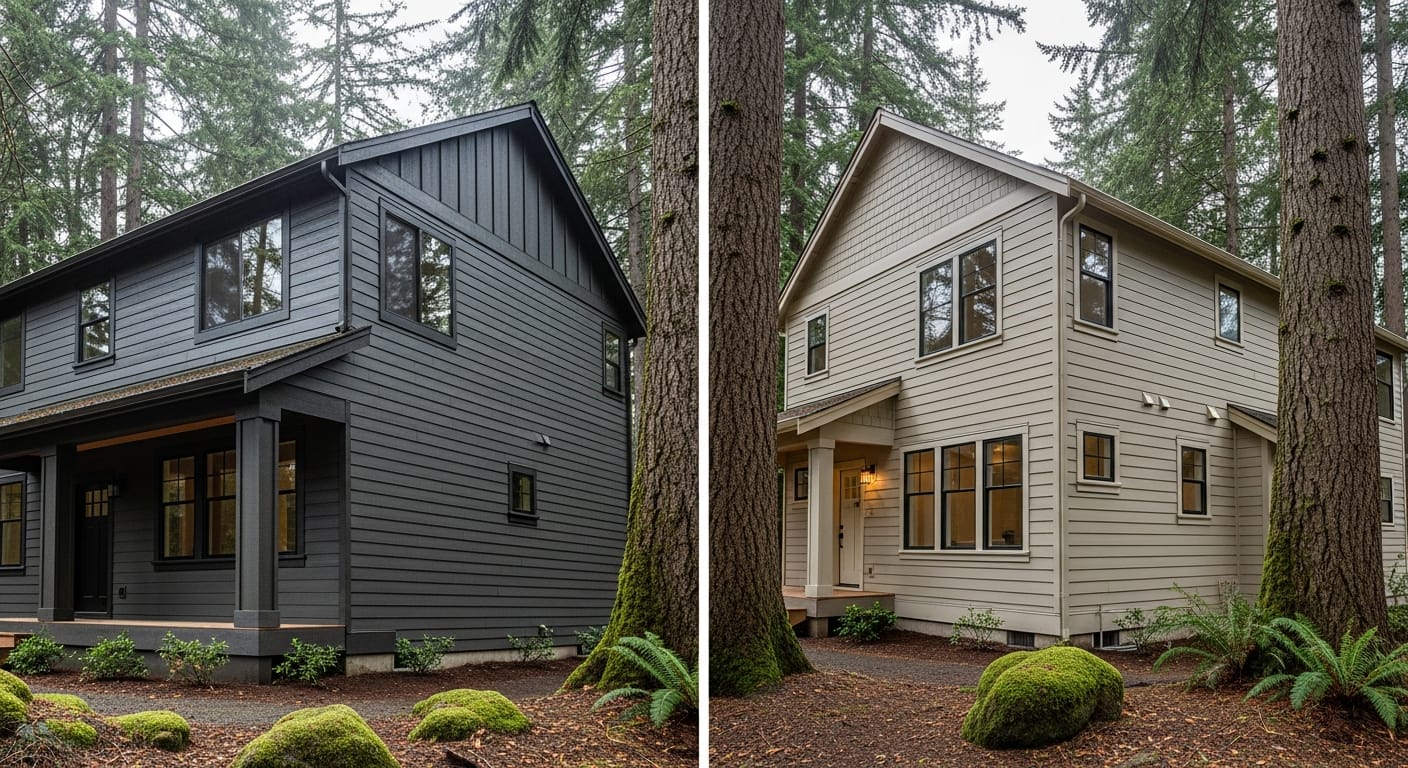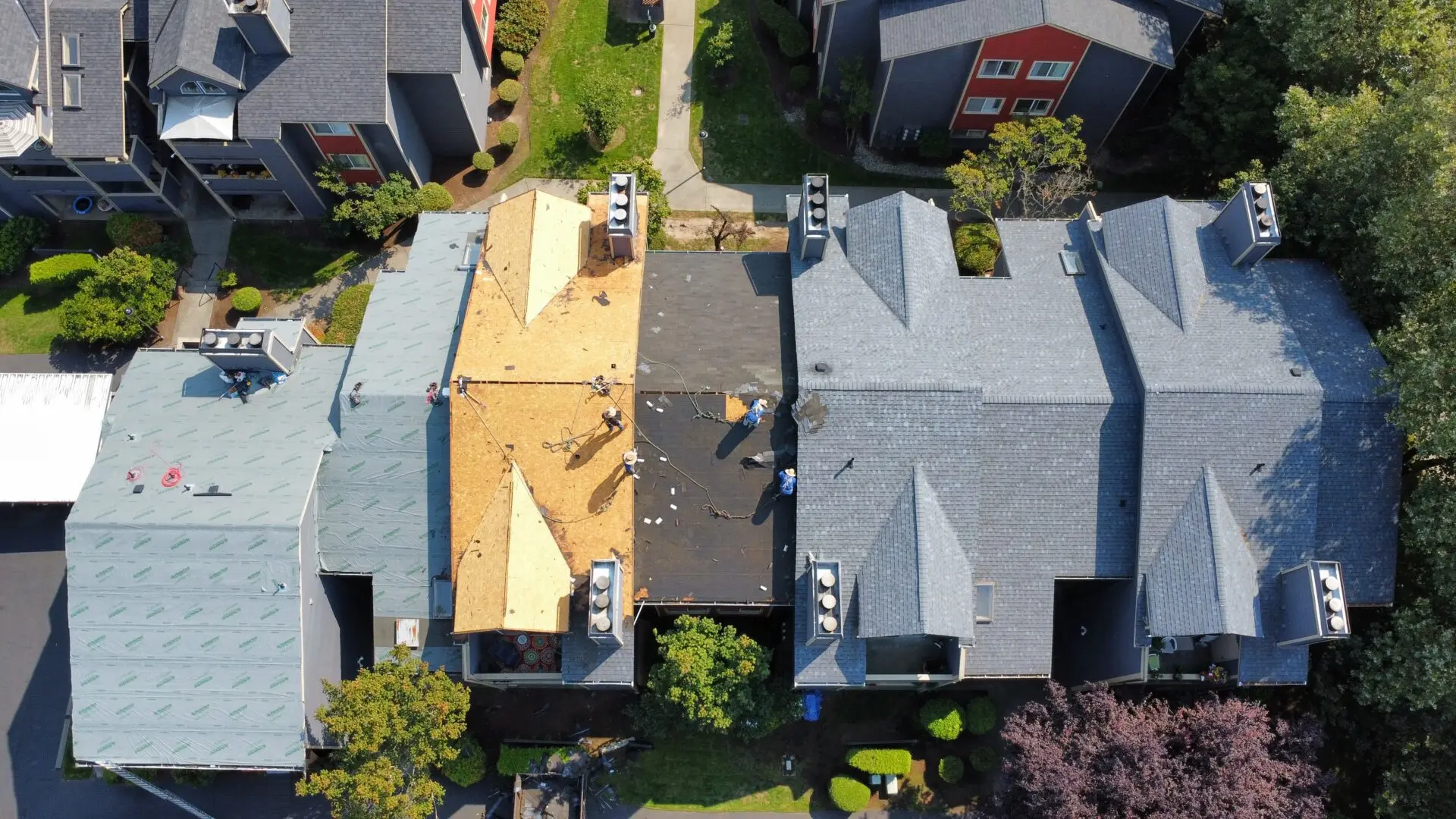
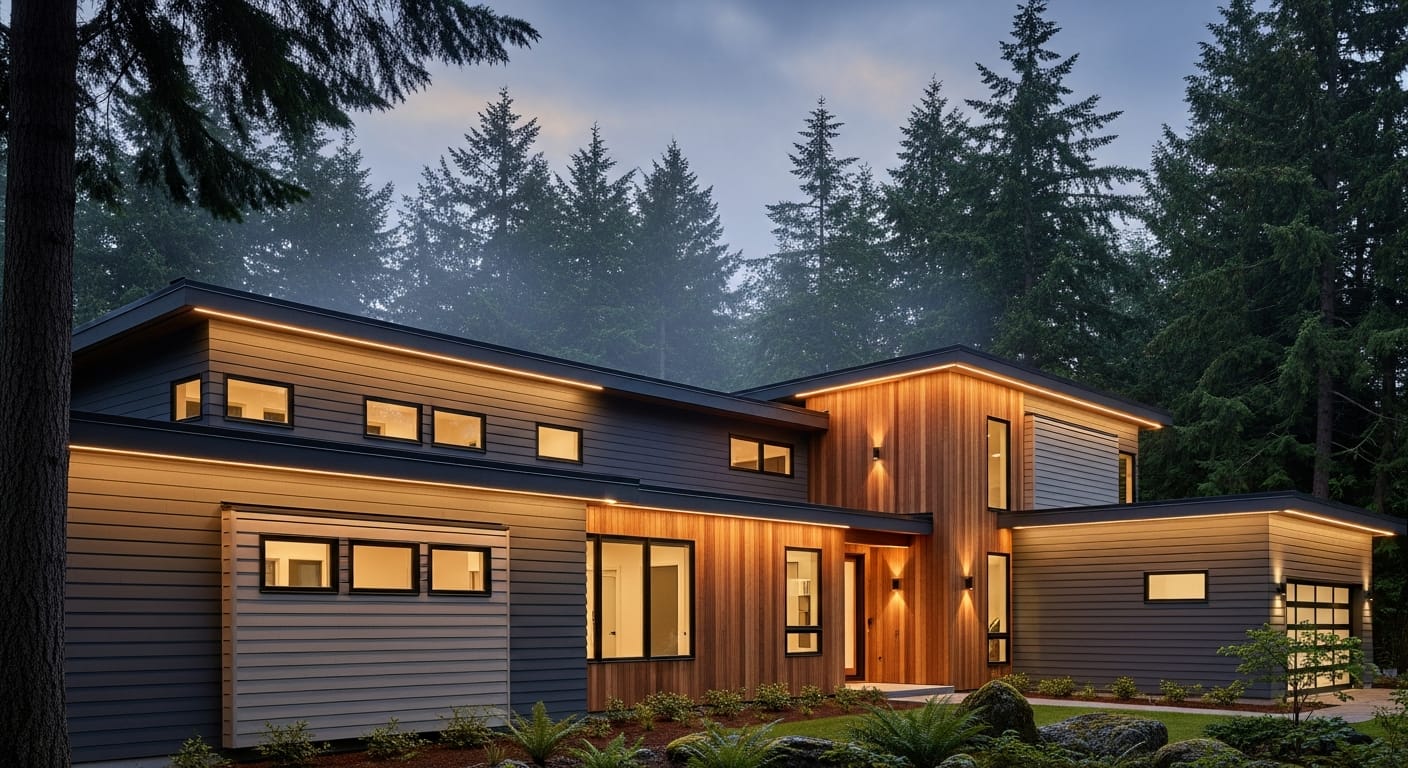
The best siding materials for Pacific Northwest homes are fiber cement (James Hardie) for overall durability and moisture resistance, engineered wood (LP SmartSide) for a wood aesthetic with better weather performance than real wood, and vinyl for budget-conscious homeowners who want low maintenance. Cedar siding, while traditional in the PNW, requires significantly more maintenance in wet climates and is losing market share to fiber cement and engineered wood alternatives.
This guide compares all major siding options through the specific lens of PNW conditions: 150+ rain days, persistent humidity, moss-friendly shaded walls, and moderate temperatures.
Why PNW Weather Demands Specific Siding
Seattle’s climate creates conditions that punish materials national guides recommend.
150+ rain days per year. Constant moisture exposure means siding is wet for far more time than in drier climates. Materials that handle 100 rain days per year fine often fail under PNW conditions.
Limited direct sunlight. Reduced UV exposure has tradeoffs. Less paint fading, but also less drying between rain events. Damp surfaces persist for hours or days that would dry in 30 minutes elsewhere.
Moss and algae. North-facing walls and walls under trees are prime moss territory. Surfaces that grow moss accelerate moisture damage.
Moderate temperatures. Less extreme heat that accelerates UV damage in southern climates. Less freeze-thaw stress than northern climates. But also less thermal cycling that helps materials dry.
High humidity. Even on dry days, humidity stays elevated. Moisture trapped behind siding cannot escape efficiently.
National “best siding” guides written for sunny Phoenix or temperate Atlanta miss these factors entirely. A material that earns A-grade reviews nationally may earn C-grade performance in Seattle.
Siding Materials Ranked for PNW Performance
| Material | Moisture Resistance | Maintenance | PNW Lifespan | Cost / Sq Ft | PNW Rating |
|---|---|---|---|---|---|
| Fiber cement (James Hardie) | A+ | Low | 35–50 years | $6–$12 | Best overall |
| Engineered wood (LP SmartSide) | A | Low–Moderate | 28–40 years | $5–$10 | Best wood alternative |
| Vinyl | A (won’t rot) | Very low | 25–35 years | $3–$7 | Best budget |
| Composite siding | A+ | Very low | 35–50 years | $6–$14 | Best premium synthetic |
| Cedar (real wood) | C+ (requires sealing) | High | 22–35 years | $8–$16 | Beautiful but demanding |
| Standing seam metal | A+ | Very low | 40–60 years | $7–$15 | Best modern aesthetic |
The ratings reflect PNW conditions specifically. In drier climates, several of these rankings shift.
Fiber Cement Siding (James Hardie) in Seattle
Fiber cement dominates the PNW siding market for good reason.
What It Is
Fiber cement is engineered from cement, sand, and cellulose fiber pressed into siding planks, panels, or shingles. The material is rigid, dimensionally stable, and essentially impervious to moisture damage. It does not rot, does not absorb water meaningfully, and resists fire, pests, and impact damage.
James Hardie’s HardieZone System
James Hardie engineers its products for specific climate zones. HardieZone 10 (covering western Washington, Oregon, and similar high-moisture regions) is specifically formulated to handle constant rain, persistent humidity, and moss-prone conditions.
ColorPlus Factory Finish
Hardie offers ColorPlus factory-baked color in dozens of options. The factory finish is more durable than field-applied paint and comes with a 15-year color warranty. Many homeowners choose ColorPlus to avoid repainting maintenance for 15 to 20 years.
Field-painted Hardie also performs well but requires repainting every 12 to 18 years in PNW conditions.
Available Profiles
- HardiePlank lap. The most common profile. Horizontal lap siding with various textures.
- HardieShingle. Cedar shingle look, often used as an accent.
- HardiePanel. Vertical panel for board-and-batten or modern designs.
- HardieTrim. Coordinating trim and accessories.
PNW Performance
Hardie installations in Seattle from the early 2000s are still performing well after 20+ years. Properly installed Hardie with maintained caulking can reasonably be expected to outlast 30 years and approach 50 years in many cases.
Maintenance Reality
- Annual soft wash to remove dirt and biological growth
- Caulking inspection annually, recaulk failed sections
- Repaint every 15 to 20 years (factory finish) or 12 to 15 years (field paint)
- Touch up any chips or exposed cut edges promptly
That’s it. No staining, no sealing, no major restoration projects.
Engineered Wood Siding (LP SmartSide)
The leading alternative to real cedar with better PNW performance.
What It Is
LP SmartSide and similar engineered wood products use treated wood strands or fibers bonded with resins and pressed into siding planks. The treatment process makes the wood resistant to moisture, decay, and insects while preserving the wood appearance.
SmartGuard Treatment
LP’s proprietary SmartGuard process treats wood strands with zinc borate (insect and decay protection) and bonds them with phenolic resins. The result is a product that looks like wood but performs more like fiber cement in PNW conditions.
Available Profiles
- Lap siding. Various widths and textures.
- Panel siding. Vertical panels for board-and-batten.
- Shingle siding. Cedar shingle look.
- Trim and accessories.
PNW Performance
LP SmartSide handles PNW moisture far better than real cedar. Treatment prevents the rot, cupping, and warping that plague natural wood in wet climates. Color retention is good, though painting every 7 to 10 years is recommended.
Cost Comparison
LP SmartSide typically costs $5 to $10 per square foot installed, slightly less than fiber cement and significantly less than premium cedar. The total installed cost for an average 2,000 sq ft Seattle home runs $12,000 to $25,000.
Why It’s Gaining Market Share
Cedar’s dominance in the PNW is fading because:
- Maintenance demands exceed what most modern owners want to invest
- Quality cedar is increasingly expensive and harder to source
- Engineered alternatives like LP SmartSide deliver similar aesthetics with much better performance
For homeowners who want the wood look without the maintenance, LP SmartSide is often the right choice.
Vinyl Siding in the Pacific Northwest
The honest assessment of vinyl in 2026.
Strengths
- Lowest cost. $3 to $7 per sq ft installed, roughly half the cost of fiber cement.
- Will not rot. PVC plastic does not absorb moisture or rot. PNW rain does not directly damage vinyl.
- Minimal maintenance. Wash occasionally, no painting required.
- Fast installation. Vinyl crews can install efficiently, reducing labor costs.
- Wide color options. Modern vinyl comes in dozens of colors with through-color technology that hides scratches.
Weaknesses
- Aesthetic limitations. Vinyl looks like vinyl. From a distance, modern vinyl can pass for fiber cement, but up close the difference is obvious.
- Fading over time. Even premium vinyl fades over 15 to 25 years.
- Cracks in cold. Vinyl becomes brittle in extreme cold and can crack from impact.
- Lower resale value. Vinyl-clad homes typically appraise lower than equivalent fiber cement homes in Seattle’s market.
- Insulation matters. Standard vinyl provides minimal insulation. Insulated vinyl options exist at higher cost.
Insulated Vinyl
Insulated vinyl (vinyl with foam backing) addresses two of vinyl’s weaknesses:
- Adds R-value (typically R-2 to R-4)
- Provides rigidity that improves the look and feel
- Costs $5 to $7 per sq ft installed vs $3 to $5 for standard vinyl
For homeowners who want vinyl’s price advantage with better appearance and energy performance, insulated vinyl is often worth the upgrade.
When Vinyl Makes Sense
- Strict budget. When the $7,000 to $15,000 difference between vinyl and fiber cement matters.
- Investment property. Where ROI calculation favors lower upfront cost.
- Short-term ownership. Selling within 2 to 3 years means you cannot recoup the fiber cement premium.
- Outbuildings. Detached garages, workshops, sheds where premium siding is overkill.
Cedar Siding: Honest Assessment for PNW
Cedar is the traditional PNW siding choice, and we install it for homeowners who want it. But the honest reality is that cedar is losing market share for legitimate reasons.
What Cedar Does Well
- Beauty. Real cedar has natural variation, depth, and aging character that synthetic alternatives cannot fully replicate.
- Authenticity. For historic neighborhoods, certain architectural styles, and specific aesthetic goals, real cedar is the right choice.
- Insulation. Cedar provides modest insulation value naturally.
- Renewable resource. Sustainable wood products from responsibly managed forests.
Where Cedar Struggles in the PNW
- Maintenance demands. Cedar requires sealing every 3 to 5 years, staining or painting every 5 to 7 years, and ongoing moss treatment.
- Rot risk. Cedar absorbs moisture and rots when not properly maintained. PNW conditions accelerate this dramatically compared to drier climates.
- Cost over time. The maintenance cost over 30 years of cedar ownership often exceeds the upfront premium of fiber cement.
- Skilled installation required. Quality cedar installation requires careful attention to ventilation behind the siding, proper flashing details, and correct fastening. Generalist contractors often install cedar incorrectly, leading to early failure.
When Cedar Still Makes Sense
- Historic homes where cedar is required for authenticity
- Northwest contemporary architectural styles where real wood is the aesthetic goal
- Owners committed to ongoing maintenance investment
- Specific HOA or design review requirements
For most modern Seattle homeowners, engineered wood (LP SmartSide) or fiber cement with a wood-grain texture deliver 90% of the cedar look with 30% of the maintenance.
Composite Siding (Synthetic Shake and Panel)
A growing premium category.
What It Is
Composite siding uses engineered polymers (often with fiber reinforcement) shaped and colored to look like cedar, slate, or other premium materials. It combines the appearance of natural materials with the performance of modern synthetics.
PNW Performance
Composite siding typically outperforms even fiber cement on moisture resistance because it does not absorb water at all. UV stability is excellent on premium products. Color is typically through-the-product, eliminating fade-related repainting needs.
Cost
$6 to $14 per sq ft installed, depending on profile and quality. Premium composite shake and slate alternatives sit at the high end.
When It Makes Sense
- Homeowners who want cedar shake aesthetics without cedar maintenance
- Modern home designs where panel composite siding fits the architecture
- Long-term ownership where lifecycle cost favors premium materials
Standing Seam Metal Siding
For modern home designs.
What It Is
Standing seam metal siding uses the same construction as standing seam metal roofing: vertical panels with raised seams that interlock. Most installations use galvalume steel or aluminum.
PNW Performance
Excellent. Metal siding is impervious to moisture, fire, pests, and UV. The only PNW-specific consideration is moss prevention on north-facing walls (similar to roofing).
When It Makes Sense
- Modern, contemporary, farmhouse, or industrial aesthetic
- 40 to 60+ year ownership horizon
- Premium home where appearance matters
Cost
$7 to $15 per sq ft installed. Higher for premium finishes and complex installations.
Choosing the Right Siding for Your Home
The decision framework:
Choose fiber cement when:
- Forever home or 15+ year ownership
- Want low maintenance with premium appearance
- Maximizing resale value
- Wood aesthetic without wood maintenance
- Most Seattle homes most of the time
Choose engineered wood (LP SmartSide) when:
- Want true wood look on a moderate budget
- Cedar’s maintenance is too much but vinyl looks too cheap
- 25 to 30 year ownership horizon
- Painting/staining every 7 to 10 years is acceptable
Choose vinyl when:
- Strict budget
- Investment property or rental
- Selling within 2 to 3 years
- Outbuildings or accessory structures
- Energy efficiency upgrade with insulated vinyl
Choose cedar when:
- Historic home requiring authenticity
- Northwest contemporary architecture demanding real wood
- Committed to ongoing maintenance
- Cost is not the primary concern
Choose composite when:
- Want cedar shake or slate aesthetic
- Premium home with architectural specificity
- Long-term ownership where lifecycle cost favors premium
Choose standing seam metal when:
- Modern, farmhouse, or contemporary design
- 40+ year ownership horizon
- Premium home where appearance is the priority
Schedule a Free Siding Consultation
K Single Corp installs all major siding materials across King, Snohomish, and Pierce counties. We provide honest material recommendations based on your home, budget, ownership horizon, and aesthetic goals, not based on which material has the best margin.
Schedule your free consultation or call (206) 659-4349. For interactive cost estimates, try our siding calculator.
For more on related topics, see our siding service page, our companion guides on fiber cement vs vinyl siding for Seattle, signs you need new siding, and siding maintenance guide for PNW homes, and our siding portfolio for real Seattle project examples.